


Although heat pump prices have been falling recently, this is by no means a small investment. A quality heat pump can cost you more than 10 thousand euros. The purchase and installation of a heat pump needs to be considered carefully.

No wonder every one of us has by now thought at least once about how to cut our energy costs. After all, an average family of four spends roughly 1 500 euros a year on energy. In villages, many people are returning to heating with wood. Putting up with acrid smoke in the village and getting up at night to tend the boiler has simply won out over the current prices of the other commodities that heat can be made from. Heat pumps, however, are also coming into fashion. They make use of the heat available in the air, the ground, or water. The heat is essentially free – all you have to do is “pump” it from outside and bring it into your home. For every kilowatt-hour of energy used to run the compressor, you can obtain two to five times as much energy for heating, water heating, or cooling. Heat pumps are used mostly in family homes, but they are also suitable for public buildings and businesses.
How does a heat pump work?
A heat pump is essentially a refrigerator in reverse. While a refrigerator creates cold inside and releases heat through its condenser, a heat pump draws heat from the colder outdoor environment and delivers it at a higher temperature into the heating system. The main component of a heat pump is a compressor driven by electricity, or possibly gas. Depending on the primary heat source a heat pump uses, there are several types: air-to-water, ground-to-water and water-to-water.
Proper installation of the heat pump is essential
Although heat pump prices have been falling recently, this is by no means a small investment. A quality heat pump can cost you more than 10 thousand euros. The purchase and installation of a heat pump needs to be considered carefully. With the right installation, the investment in a heat pump can pay for itself within as little as five years. However, the Slovak Innovation and Energy Agency (SIEA) points out that a proper installation is not a given. “Given the wide range of technologies and possible technical solutions, the results depend more than in other cases on a high-quality, tailor-made design. The experience, responsibility and professional competence of the supplier are essential,” the agency adds.
When will your investment pay off?
The following chart shows the approximate return on investment for heating with various heat pumps over the individual years of use. The payback is derived from the specific price of the system in euros per installed kilowatt of output at the heat pump outlet.
Chart: Return on investment for heat pump installations:
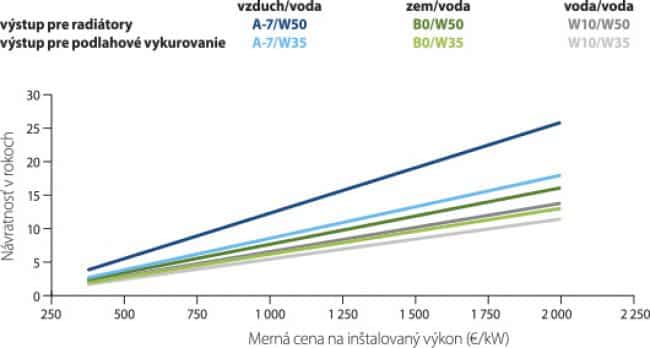
Note: The results shown in the chart correspond to heat pumps that deliver 2 300 kWh of heat per year per 1 kW of installed output. The calculation used the SPF values from the table on page 5 and an electricity price of 0,135 €/kWh. The cost savings were calculated at a heat price of 0,10 €/kWh (28 €/GJ). For the air-to-water heat pump, a 16 % need for supplementary electricity was included for days with an average temperature below -7 °C in climate zone II.
The lifespan of heat pumps suitable for family homes is around 20 years. However, that applies only to ground-to-water and water-to-water heat pumps. For the air-to-water type it is about 15 years. Circulation pumps typically last 10 to 15 years. A pump’s lifespan can be extended by replacing the compressor. “A heat pump’s lifespan is fundamentally affected by how often the compressor is switched on and whether it is run at maximum load for unreasonably long periods. That is why quality control and correct system sizing are essential,” adds SIEA.
Important information
When buying a heat pump, you should watch two important figures: the instantaneous coefficient of performance – COP, and the seasonal performance factor – SPF. The COP figure, which every manufacturer should state in their catalogue, expresses the main advantage of a heat pump over other technologies used to produce heat. It is the ratio of heat output to electrical input. It cannot be compared without knowing the conditions under which it was determined, as it is just one point on the unit’s actual operating curve. For example, the same heat pump in temperature mode A7 (outdoor air temperature 7 °C) /W35 (heating water outlet temperature 35 °C) may have a COP of 3,90. That is a more tempting claim than stating a COP of 3,22 in A2/W35 mode, or just 2,95 for A2/W55.
The seasonal performance factor (SPF) is the ratio of the heat produced at the pump’s output over one year to the total energy consumed per year, i.e. the electricity “burned”. Only some manufacturers state the SPF, because the installation conditions also need to be taken into account. “It is, however, a key parameter of the system, because when evaluating the actual results achieved and the return on investment, what matters is the overall energy and cost balance,” adds SIEA. The latest trend in comparing heat pump quality has been the introduction of the seasonal COP (known as SCOP), which, using cars as an example, could be likened to the term “combined city-road-motorway fuel consumption”. SCOP is a more accurate and more comprehensive indicator than COP, because it covers several operating modes. The mix of these modes is set by a European standard. It expresses a heat pump’s ability to operate energy-efficiently even at partial load, that is, to adapt its energy demand to the changing heating output requirement as the outdoor temperature changes.
Beware of the numbers
When buying a heat pump, “clever” salespeople can deceive a customer very quickly. For example, you should pay attention to the temperature at which the manufacturer rated the heat pump’s output. “A unit whose label states a nominal output of 12 kilowatts may deliver less heating output in real operation than a unit labelled 9 kilowatts. It is enough for the first manufacturer to have rated the output at an input primary medium temperature of +15 °C (most often outdoor air) and the second manufacturer at +2 °C,” stated SIEA, according to which the usual average outdoor air temperature during the heating season is +2 °C to +4 °C. Customers should therefore focus their attention on the parameters quoted at the lowest possible temperatures.
In preparing this text, we drew on materials from the Slovak Innovation and Energy Agency, prepared as part of the Žiť energiou free energy advice project. You can read more about this topic on this website of the Slovak Innovation and Energy Agency.
Autor: vEnergetike.sk