

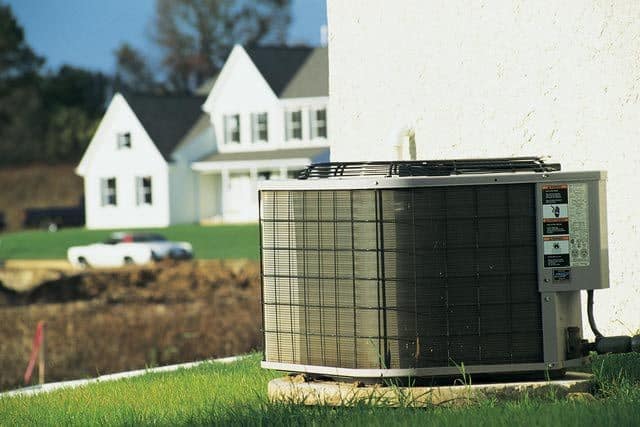

It is well known that a heat pump heats in the most economical and ecological way. But did you know that in summer it can also cool effectively?
Heat pumps work the same way as refrigerators – they can pump heat away. The only thing that matters is the direction in which the thermal energy is pumped. When heating, from outside to inside, and when cooling, from inside to outside. Every heat pump can therefore also be adapted for cooling mode. It just needs a few extra components for the technology to replace an air conditioner as well. The truth is that a heat pump with a cooling function costs roughly three to five hundred euros more than one without it.
Reversible heat pumps usually have outputs for heating or cooling and may have additional ones, for example for domestic hot water or heating pool water.
If the system is designed correctly, even the investment costs need not be high. With a well-chosen heat pump, the initial investment can pay for itself within three to seven years through energy savings. The most popular heat pumps in Slovakia are air-to-water and, in some cases, air-to-air models, which obtain heat from the surrounding air.
Chladenie vzduchom
An air-to-air heat pump is in principle a conventional air conditioner and is the simplest and cheapest heat pump heating solution. It cools by blowing air from the indoor unit, most often mounted above a door, which some people may find unpleasant. Most wall-mounted units are fitted with special sensors that, once they detect a person in the air-conditioned space, can redirect the airflow away from them. Or, conversely, if no movement is detected in the room, the cooling switches to a reduced mode after a while.
Many units are also appealing thanks to their filter systems.
Carbon filters and air ionisers, however, usually do not deliver the expected effect. The resulting difference between air that passes through such a filter and air that does not is typically unmeasurable. There are, however, models with a built-in fully fledged air purifier, and these really can clean the air properly. Their price, though, is usually five hundred to a thousand euros higher.
A more comfortable option is a system of ducted units, where heating or cooling is distributed through air ducts across the building to the required zone. In this case, cooling can be customised to the maximum – you can adjust the airflow speed and route it so that it is as unobtrusive as possible, blowing towards the windows, for example. Noise is also eliminated, because the indoor unit is located outside the air-conditioned rooms, and properly sized ductwork can almost completely prevent noise from spreading through it.
When water does the cooling
Besides heating water, an air-to-water heat pump can also produce chilled water and use it to cool the interior. The heat pump’s outdoor unit looks like a conventional air conditioner, while the indoor unit is a so-called hydrobox with a heat exchanger, from which the chilled water is piped to the terminal cooling element. Suitable terminal elements for distributing the cooling are wall or ceiling heating systems, in rare cases underfloor heating, or fan coil units. Because of moisture condensation, conventional radiators cannot be used; low-temperature radiators might be partly usable, but even their efficiency is very low and usually negligible.
Fan coils work much like conventional air conditioning.
Cold water chilled in the heat pump enters the fan coil; a fan blows air across the heat exchanger and delivers cool air into the room. The exchanger surface is relatively small, so its surface temperature must be very low – typically five to ten degrees Celsius – for the room air to be cooled effectively. However, moisture contained in the warm air condenses on such a cold surface, and roughly 10 to 20 percent of the energy is consumed producing condensate.
Wall or ceiling cooling is more effective and efficient, as it delivers the full cooling output.
A pipe register similar to underfloor heating runs through the structure, carrying a cool liquid that chills the surface of the ceiling or wall, and from there the whole room is cooled by radiation. The water temperature in the pipes is relatively high, around 17 to 22 degrees Celsius, so that the ceiling temperature does not drop below the dew point in the interior. Otherwise, airborne moisture would condense on it, which would reduce its efficiency and damage the building structures and the interior, and would also create an unhealthy environment with conditions for the spread of mould and the like. The cooling surface of the ceiling is many times larger than the heat exchanger surface of fan coils, so even at its higher temperature it cools the interior pleasantly.
Sophisticated air-to-water and air-to-air heat pump models can also use waste heat as part of a home’s controlled ventilation system and function as a heat recovery unit.
Expert advice: Peter Oslanec
Which cooling system is best?
Cooling your home with a heat pump is a matter of comfort. It can also be done more cheaply by mounting a single fan coil on the wall, which costs two to three hundred euros without extra features. Shared ducted fan coils for several rooms combined with a heat pump are somewhat more expensive, and it is also difficult to balance the system so that the temperature in one space differs from another. Technically, the whole system can be automated in terms of temperature control, but this makes it considerably more expensive. In that case ceiling cooling is better and more economical: the entire building structure is cooled slightly and radiant cooling keeps the space from overheating with minimal energy consumption.
During the summer season, a cooling system with a heat pump combined with an ideal cooling element can achieve a seasonal efficiency rating (SEER) of around 10, which means that from one kilowatt of electrical energy you can obtain up to 10 kW of cooling energy.
In winter, in turn, paired with an ideal heating system or emitter, we can achieve a seasonal coefficient of performance (SCOP) of around 6, which means that from one kilowatt of electricity we can obtain up to roughly 6 kW of heating energy. There are systems that can cool and heat at the same time. The advantage of heat pumps is that in the transitional season, at an outdoor temperature of +15 °C, south-facing rooms may already be overheated and need cooling, while you will still want to heat the north-facing ones. And in this period their efficiency is significantly higher than their SCOP or SEER.
More demanding
Heat pumps that use heat from the ground or groundwater for heating and water heating are more demanding to install and require a higher initial investment. Although they achieve better operating parameters and greater savings on operating energy, these make up only part of the true cost of running them. For ordinary family houses, the investment usually does not pay off given the higher maintenance requirements. Relative to the higher investment costs, they only become worthwhile at higher outputs, for example 100 kW and the like.
Author: PEKNÉ BÝVANIE/Adela Motyková, pluska.sk