


Every household uses the largest share of its energy for heating and domestic hot water. Given the high prices of heating oil and natural gas, heat pumps are a particularly attractive alternative, especially for new builds – but also as a replacement for old heating systems.
Heat pumps use heat from the surrounding environment – from the ground, from groundwater or from the air – and provide heat for space heating and domestic hot water all year round. They significantly reduce energy costs, avoid burning fossil fuels and cut carbon dioxide CO2 emissions by more than 40 percent.
How a heat pump works
The principle of the heat pump has been known for more than 100 years. The designer of the world’s first heat pump was the Slovak Aurel Stodola. His heat pump from 1928 still operates in Switzerland today, heating the town hall in Geneva by drawing heat from the lake’s water (a closed circuit). The first major technical application of this method of heating took place in 1936. However, wider use of heat pumps for heating only came with the rise in energy prices at the beginning of the 1970s.
Just as an ordinary refrigerator in your home keeps cooling even when the outdoor temperature is, say, +30°C, heat pump technology keeps heating even when the temperature of the medium it draws energy from is low or even below zero. It is all based on heat transfer using a liquid with an extremely low evaporation point.
Heat pump for heating is a device that uses unconventional energy sources for central heating (CH) and for heating domestic hot water (DHW). It works on the principle of using otherwise unusable energy – low-potential heat from our surroundings (i.e. from water, air, the ground or waste heat) – which, by being pumped, is raised to a temperature usable in the heating system. The fundamental promise of heat pumps is that no heat from the combustion of any fuel is added directly to the planet’s global temperature regime. Indirectly, a certain amount of heat is generated in power plants – when producing the electricity consumed to run the heat pump.

How an air-to-water heat pump works
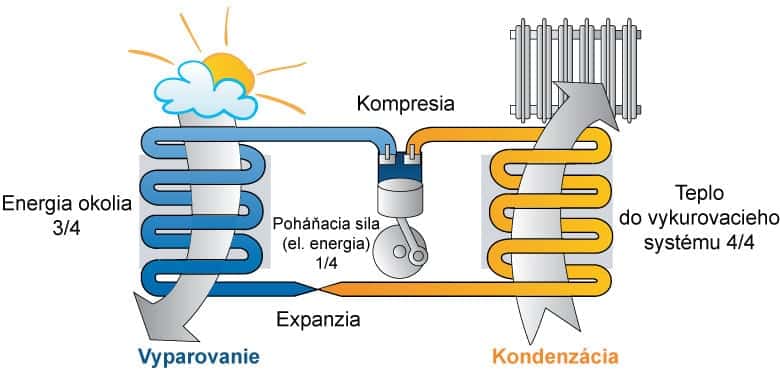
At the heart of a heat pump is a closed circuit filled with refrigerant. A heat pump – or rather its refrigeration circuit – has four basic parts:
- Evaporator: Low-potential heat is delivered to the evaporator by the surrounding air. The supplied heat causes the refrigerant to evaporate; the refrigerant vapour becomes the carrier of the thermal energy and carries it to the compressor. The air, driven through the evaporator by an axial fan or fans, is cooled in the process. The air path forms the primary circuit of the heat pump.
- Kompresor: it draws in vapour from the evaporator, compresses it and pushes it into the condenser. The work used to drive the compressor is converted into heat, which is added to the heat supplied to the evaporator.
- Condenser: the energy brought into the condenser by the refrigerant vapour from the evaporator and the compressor is transferred to the circulating heating medium (the heat pump’s secondary circuit). The transferred heat warms the heating medium.
- Expansion valve: the liquid refrigerant that condensed in the condenser at the higher (condensing) pressure is injected into the evaporator, where it evaporates again at the lower (evaporating) pressure.
In this way, heat pumps can raise the heat from these media (at a temperature of, say, around 2°C) to a higher temperature level (e.g. around 80°C), but to do so they need a supply of additional energy, usually electricity. However, the heat gained from the surrounding environment for heating is greater than the electricity consumed to drive the heat pump: from 1 kWh of electricity consumed, it is typically possible to obtain 3 to 4 kWh of heat.
Types of heat pumps
Essentially, 3 types of heat pumps are manufactured today. Their designation relates directly to the type of medium from which they draw their source energy. The systems in use are:
- Vzduch/Voda – thanks to its undemanding installation, probably one of the most widely used systems today. The pump draws energy from the surrounding outdoor air. Naturally, the higher the outdoor air temperature, the greater the heat gain, but the pump can be operated at a respectable output down to a temperature of –15°C.
- Voda/Voda – in this case the source medium is water; the pump’s heat collector is placed on the bottom of a pond, river, pool or other body of water. Even though this solution requires such a source close to the installation, it is widely used today.
- Zem/Voda – a very popular system, especially for new builds. The medium is the ground, in which the pump’s heat collector is placed at a frost-free depth. A deep borehole can also be used. The GROUND/WATER heat pump product range is sometimes also referred to as WATER/WATER, because the water entering the heat pump has been warmed in the ground.
Weather-compensated control
A control system that adjusts the temperature of the heating water entering the heating system according to the outdoor temperature. For example: when it is -15°C outside, the control sends water at a temperature of, say, 50°C into the house; when it is 10°C outside, it sends water at only 30°C. Weather-compensated control is far more important for heat pumps than for other heat sources, because the lower the heating water temperature, the more efficient and economical the heat pump’s operation.
I would recommend coating all pipes and distribution lines with ThermoShield TopCoat, which reduces heat losses in the heating distribution pipes and minimizes the risk of water condensation. More about ThermoShield TopCoat metal coating can be found in a separate article.
Domestic hot water heating – connecting the heat pump to a storage tank
A frequent question is whether the pump can be connected to a storage tank and used to heat domestic hot water. Yes, of course – a heat pump can be connected to a hot water tank, saving you considerable money on water heating all year round. In this combination, it is important to install quality weather-compensated control and not to control the heat pump with a thermostat alone.
Is a heat pump worth the investment? Will it pay for itself?
Yes, it’s worth the investment. Technological progress has made these systems significantly cheaper, bringing the payback period for a family home down to roughly 7-10 years. In commercial and industrial operations, or when deployed in apartment blocks and residential buildings, the payback period of a heat pump is a matter of just a few years. And with energy prices rising by 5 % or more every year, the payback period of a heat pump keeps getting shorter.

Lower radiator temperature
Some people complain that a heat pump doesn’t heat enough. This impression is caused simply by the fact that the radiator in the room has a surface temperature lower than 60°C, so people think the room is cold even though the thermometer shows the same 22°C as with high-water-temperature radiators. After a while, everyone gets used to this sensation.
As an interior coating, I would recommend using ThermoShield Interieur, which creates a comfortable indoor climate and maintains constant humidity. The ThermoShield Interieur thermoceramic membrane ensures an even distribution of heat throughout the room. The temperature difference between the floor and the ceiling can thus be less than 2°C. At the same time, it prevents condensation forming on the walls and mould growth. You can also cut down on ventilation, through which expensively gained heat literally flies out of the window.
Walls finished with ThermoShield Interieur paint create a large ceramic surface and therefore act during the cold months much like a tiled stove, radiating its pleasant warmth into the room. The hollow ceramic microspheres contained in the paint ThermoShield, they conduct heat like a “mini-stove”. Thanks to its properties and the considerably enlarged wall surface, the coating quickly and effectively distributes radiant heat from the heat source to the more distant wall and ceiling surfaces. The stove now “radiates” heat into the room much more evenly. At the same time, it “draws out” excess moisture from the walls and releases it into the air. This is crucial for the insulation effect, because dry walls insulate far better than damp ones.
The heat pump has its own electricity supply
A heat pump is normally connected to the existing electricity supply (if it is sufficient; if not, it needs to be upgraded). What’s more, all electricity suppliers offer special heat pump tariffs with a lower electricity price than standard tariffs. And the whole house runs on this cheaper energy.
Choosing the right heat pump is important
Installing a heat pump into an existing system is very simple, but choosing the right heat pump is a little more complex. First, the heating system must be assessed and the building’s heat loss calculated. Based on this information, it is then decided how large a heat pump to install and with what heating water temperature. In 80% of renovation projects it turns out that there is no need for a heat pump with a high heating water temperature, which costs hundreds of EUR more.
Autor: Peter Hofer